
 +380 67 346 44 89
Low Season in Bukovel (2026): Travel, Transfers, Weather, Roads, and Planning
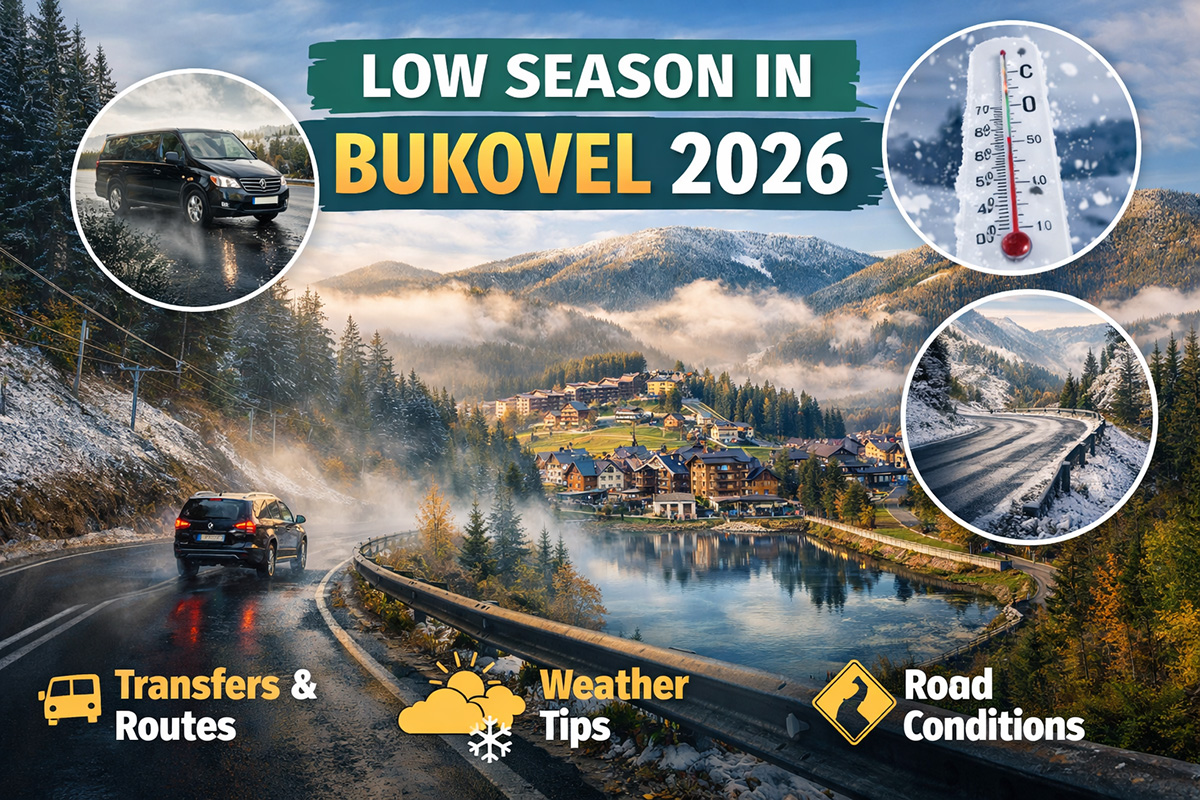
Bukovel is often associated with peak winter weekends and holiday crowds. Low season is different: fewer people on the roads, more availability in hotels, and a calmer pace across the resort area. In 2026, low season remains the best format for travelers who value predictability, privacy, and flexible daily schedules, but it requires slightly different planning than a classic “arrive Saturday, ski Sunday” trip.
This page focuses on low-season logistics and practical details: how to get to Bukovel when public schedules are less frequent, what to expect from the weather in the mountains, how road conditions can change, and how pricing usually works for transfers. The goal is to make the trip feel simple even when the resort is between peak waves.
What “Low Season” Means in Bukovel in 2026
Low season is not one fixed period; it is a combination of weeks when the resort and the surrounding villages operate in a quieter mode. In Bukovel, low season most often appears in “shoulder” windows:
- Spring shoulder (after the main winter peak): warmer days, softer snow or mixed conditions, more rain in the valleys, and fewer travelers on weekdays.
- Autumn shoulder (before the stable snow season): cooler evenings, foggy mornings, and a transition from hiking weather to early frost.
- Short quiet gaps between major holiday dates: the resort can feel calm even in winter when demand temporarily drops.
In low season, the core infrastructure of the destination remains in place (roads, hotels, private services, grocery stores, pharmacies), but the rhythm changes. Some restaurants switch to shorter hours, some activities may be offered only on specific days, and public transport can be less frequent. For travelers arriving from outside the region, the main difference is not “what exists,” but “how reliably it runs on a fixed schedule.”
Why Low Season Can Be the Best Time for a High-Comfort Trip
Low season is often chosen by travelers who care more about comfort than the social energy of a packed resort. Typical low-season advantages in Bukovel include:
- Faster arrivals and departures: less traffic at common choke points, fewer delays during check-in hours, and easier luggage handling.
- More hotel choice: higher availability for premium rooms, chalets, and family apartments; more flexibility with preferred views and layouts.
- Quieter dining: less waiting, easier reservations, and a calmer atmosphere.
- Better space for wellness: spas, pools, saunas, and private wellness sessions can be easier to schedule.
- More personal service: drivers, guides, and private services can often adapt to time changes and special requests more easily than in peak season.
The trade-off is that low season rewards planning. If the trip includes an airport arrival, a late-night train, or a return transfer at a specific hour, relying on ad-hoc public transport can create unnecessary uncertainty. In low season, the simplest solution is usually a pre-arranged transfer that connects the exact pickup point to the exact hotel address.
What Can Be Limited in Low Season (and How to Avoid Surprises)
Low season does not mean “closed resort,” but it can mean “reduced frequency.” The most common limitations travelers notice are:
- Public transport frequency can be lower, and the last departure can be earlier than expected.
- Some entertainment schedules can shift to weekends or specific days.
- Restaurants and cafes may operate on shorter hours in quieter weeks.
- Weather sensitivity increases: fog, rain, early snow, or icy nights can affect travel time in the mountains.
For a smooth trip, the key is to treat transportation as the “fixed part” of the itinerary. Once arrival and departure are guaranteed, everything else becomes flexible and comfortable.
Weather in Bukovel During Low Season (2026)
Bukovel sits in a mountain environment where weather changes are normal. Low season often has wider daily variability than the stable cold of mid-winter. A sunny day can turn into rain in the late afternoon; a mild evening can become an icy morning; fog can reduce visibility even when the forecast looks acceptable in the lowlands.
Typical low-season weather patterns in the Carpathians include:
- Fog and low clouds in mornings and evenings, especially in transitional months.
- Rain in the valleys while the resort area experiences colder wind or mixed precipitation.
- Overnight icing when daytime temperatures are above freezing but nights drop below.
- Wind exposure in open areas: it can feel significantly colder than the air temperature suggests.
Practical clothing planning for low season usually includes layered items, waterproof outerwear, and footwear suitable for wet or muddy surfaces. Even travelers who come for a “relaxed hotel + spa” weekend often appreciate having one set of weather-proof basics, because mountain weather can change quickly during short transfers between hotels, restaurants, and activity points.
Road Conditions to Bukovel in Low Season (2026)
Roads to Bukovel remain operational year-round, but low season changes what “difficult” looks like. In peak winter, the main concern is heavy traffic and compacted snow. In shoulder periods, the road surface may shift between dry asphalt, wet pavement, mud near roadside areas, and occasional icy spots at night.
Common low-season road factors include:
- Wet pavement and reduced visibility during rain and fog.
- Slippery surfaces in the early morning due to overnight cooling.
- Local roadworks or maintenance that are easier to schedule in non-peak periods.
- Falling temperatures after sunset, which can create unexpected icy sections.
This is why many travelers prefer a driver who regularly operates in the region. Local driving is not only about “knowing the road,” but about knowing how it behaves in changing mountain conditions and where time losses can appear.
How to Get to Bukovel in the Low Season (2026)
In low season, the goal is to arrive without dependence on a tight chain of public departures. The most stable approach is a direct transfer from the arrival point (airport, hotel, train station) to the final address in Bukovel. The second-best approach is a combined route (train + pre-arranged transfer). Buses can work, but they are the least predictable in low season due to reduced frequency and higher sensitivity to weather and road delays.
Option A: Private Transfer (Door-to-Door)
A private transfer is the most predictable format in low season. It removes dependency on limited bus schedules and avoids long waiting times at stations when weather is unpleasant. It is also the simplest solution for travelers with luggage, sports equipment, children, or a preference for privacy.
Key characteristics of a private transfer in low season:
- Exact pickup at the address or terminal you specify.
- Direct route to Bukovel without transfers between vehicles.
- Comfort in variable weather: no waiting outside in rain or fog.
- Flexible timing: convenient for late arrivals or early departures.
From Ivano-Frankivsk to Bukovel
Ivano-Frankivsk is one of the most common gateways for Bukovel by air or rail. In low season, a direct transfer is usually the simplest way to avoid schedule gaps and last departures. Internal route page:
Ivano-Frankivsk → Bukovel transfer
From Kyiv to Bukovel
Kyiv is a long-distance departure point. In low season, travelers typically choose either a direct private transfer or a combined plan (train to Ivano-Frankivsk + transfer). The best format depends on timing, comfort expectations, and whether the trip is built around a strict schedule. Internal route page:
Option B: Train + Transfer (Balanced Comfort and Stability)
A combined route works well when you want the stability of rail for the long segment and the flexibility of a private vehicle for the final mountain segment. This approach is especially effective in low season because the “last-mile problem” becomes more visible: bus connections may not align perfectly with train arrivals, and waiting outside can be uncomfortable during rain, wind, or snow.
Typical structure:
- Train from a major city to Ivano-Frankivsk (or another relevant station depending on schedules).
- Pre-arranged transfer from the station directly to the Bukovel address.
Operational advantage: if the train arrival time shifts, the transfer can adapt, and the final segment remains controlled. In low season, this is often the simplest way to keep the trip calm and predictable.
Option C: Bus (Possible, but Less Predictable in Low Season)
Buses can be a workable option, especially when you travel light and your schedule is flexible. In low season, bus frequency can be reduced, and the final arrival time can be more sensitive to weather and road conditions. If you choose the bus route in low season, it is important to assume that a perfect connection is not guaranteed.
Practical low-season bus realities:
- Fewer departures can mean longer waits if you miss one.
- Some routes may be seasonal or adjusted depending on demand.
- Delays can accumulate faster in fog, rain, or early icing conditions.
Option D: Driving Yourself
Self-driving is straightforward for experienced drivers who are comfortable with mountain roads and variable weather. In low season, the main difference from peak winter is not the total road access, but the shifting surface conditions and visibility, especially in fog and after sunset.
Practical considerations for self-driving:
- Time buffer matters: fog and wet roads can slow the pace.
- Night driving can be more demanding due to visibility and possible icy sections.
- Parking is often easier in low season, but conditions depend on your exact hotel area and the weather.
- Vehicle readiness matters: tires, lights, and windshield performance are critical in mountain conditions.
If your priority is maximum comfort, minimal stress, and predictable arrival timing, a private transfer is the simplest alternative to self-driving, especially when weather is unstable.
Comparison of Travel Options in Low Season
| Option | Predictability | Comfort | Best for | Common low-season limitation |
|---|---|---|---|---|
| Private transfer | High | High | Comfort-focused travel, luggage, families, flexible timing | Price varies by route and vehicle class |
| Train + transfer | High | High | Long-distance travel with controlled final segment | Requires coordination between arrival time and pickup |
| Bus | Medium | Medium | Light luggage, flexible schedule | Reduced frequency; higher sensitivity to delays |
| Self-driving | High (if experienced) | High (depends on vehicle) | Drivers comfortable with mountain conditions | Visibility, wet roads, and occasional overnight icing |
Practical Low-Season Arrival Planning
In low season, the most useful planning principle is to separate the trip into two layers:
- Fixed layer: arrival and departure transportation, hotel address, luggage handling, and buffer time for weather.
- Flexible layer: dining choices, short excursions, spa timing, and optional activities that can move based on the day’s conditions.
This approach keeps the trip stable. If a foggy morning slows the road segment or rain makes an outdoor plan less attractive, the day can be rearranged without creating stress around the core schedule. For premium-style trips, the fixed layer is typically a door-to-door transfer, because it eliminates the least comfortable parts of low-season travel: waiting outside, searching for last departures, and managing luggage in uncertain timing.
For travelers arriving through Ivano-Frankivsk, using a direct route page and booking on that route is the simplest structure for low season:
Transfer Ivano-Frankivsk → Bukovel
For long-distance travel from the capital, the route page provides the structured format:
Low-Season Comfort: What to Do in Bukovel When It’s Quiet
Low season in Bukovel is not only about skiing. Many travelers use these quieter periods for a “mountain reset” style trip: wellness, slow mornings, clean air, and private dining. While specific activity availability can change from week to week, low season generally supports these formats well:
- Wellness and spa: pools, saunas, massage sessions, and private wellness blocks.
- Short nature trips: scenic viewpoints and short walks when weather allows.
- Local cuisine: calmer restaurants and more relaxed service pace.
- Family travel: easier movement with children due to reduced crowds and shorter lines.
Low season also improves the quality of short transfers inside the area. Moving between accommodation, restaurants, and nearby points becomes easier with less traffic and fewer parking limitations.
FAQ (2026): Prices, Weather, Roads
How much does a transfer to Bukovel cost in 2026?
Transfer pricing depends on route distance, pickup point type (airport, hotel, train station), vehicle class, number of passengers, luggage volume, and departure time. Low season can offer more flexibility, but exact cost is calculated per request because the route and service details define the final price.
What usually has the biggest impact on the price?
The main variables are the starting city, the vehicle category (standard sedan, business class, minivan), and timing. Late-night or early-morning pickups can be priced differently due to operational constraints and driver scheduling.
Is low season cheaper for transfers than peak winter?
Low season often reduces demand pressure, which can improve availability. Final price still depends on route length, vehicle, and pickup time. The primary low-season advantage is usually scheduling flexibility rather than a guaranteed price difference.
How is the transfer price calculated for families or groups?
Group pricing is usually shaped by vehicle choice: a larger vehicle increases comfort and luggage capacity. The number of passengers matters mainly because it defines the required vehicle size and the service configuration.
What is the weather like in Bukovel during low season?
Low season is the period with the highest variability. Expect quick shifts between sun, fog, rain, and colder evenings. Even when daytime temperatures feel mild, nights can cool down enough to create icy spots on roads and walkways.
Can there be snow in low season?
Yes. Depending on the period, the mountains can bring early snowfall in late autumn or late snow in spring. Snow is not the only factor; wet snow and overnight freezing can create slippery surfaces.
Is fog common in the Carpathians?
Fog and low cloud layers are common in transitional periods. Fog affects visibility and can slow travel time, especially in the morning and evening. Travel planning in low season is more comfortable when the schedule includes a buffer.
Are roads to Bukovel safe in low season?
Roads remain operational, but low season introduces different road risks than mid-winter peak: wet pavement, reduced visibility, and overnight icing. Safety depends on driver experience, vehicle readiness, and how well the route is adapted to current conditions.
Do road conditions change fast?
Yes. In the mountains, conditions can shift within hours. A dry afternoon can become a slippery late evening if temperatures drop. This is why a predictable transfer plan and realistic timing are important in low season.
Can I rely on buses in low season?
Buses can work, but low season often reduces frequency. If you miss a departure or face delays, the next option may not be immediate. Travelers who prioritize comfort and timing usually prefer a private transfer or a train + transfer combination.
What is the most stable way to arrive if I land in Ivano-Frankivsk?
The most stable format is a direct transfer from the airport or railway station to your Bukovel address, because it removes dependence on limited schedules and avoids waiting outdoors in variable weather.
What is the most stable way to arrive from Kyiv in low season?
The stable formats are either a direct transfer or a combined plan (train for the long segment + transfer for the final mountain segment). The right structure depends on timing and comfort expectations.
Does low season affect return transfers from Bukovel?
Low season can affect traffic positively (less congestion), but weather variability can introduce time uncertainty. A planned return transfer with a realistic time buffer reduces risk for flights and train departures.
What should I keep in mind for early-morning departures?
Early mornings can bring the lowest temperatures of the day, which increases the chance of icy sections and fog. Planning a buffer and using a vehicle suited for mountain conditions improves overall predictability.
Do I need special tires in low season?
Tire choice should match actual conditions. Low season can include wet roads, cold nights, and occasional snow. Vehicle readiness matters more in the mountains because conditions shift quickly and braking distance can change.
Is Bukovel worth visiting when it’s quiet?
Low season is a strong choice for travelers who value calm hotels, easier reservations, flexible schedules, and less crowded roads. It is particularly suitable for wellness-focused trips, family weekends, and travelers who prefer privacy and a slower pace.
