
 +380 67 346 44 89
Bukovel Webcams 2026: Live Cameras, Real-Time Weather, Visibility, and Trip Planning
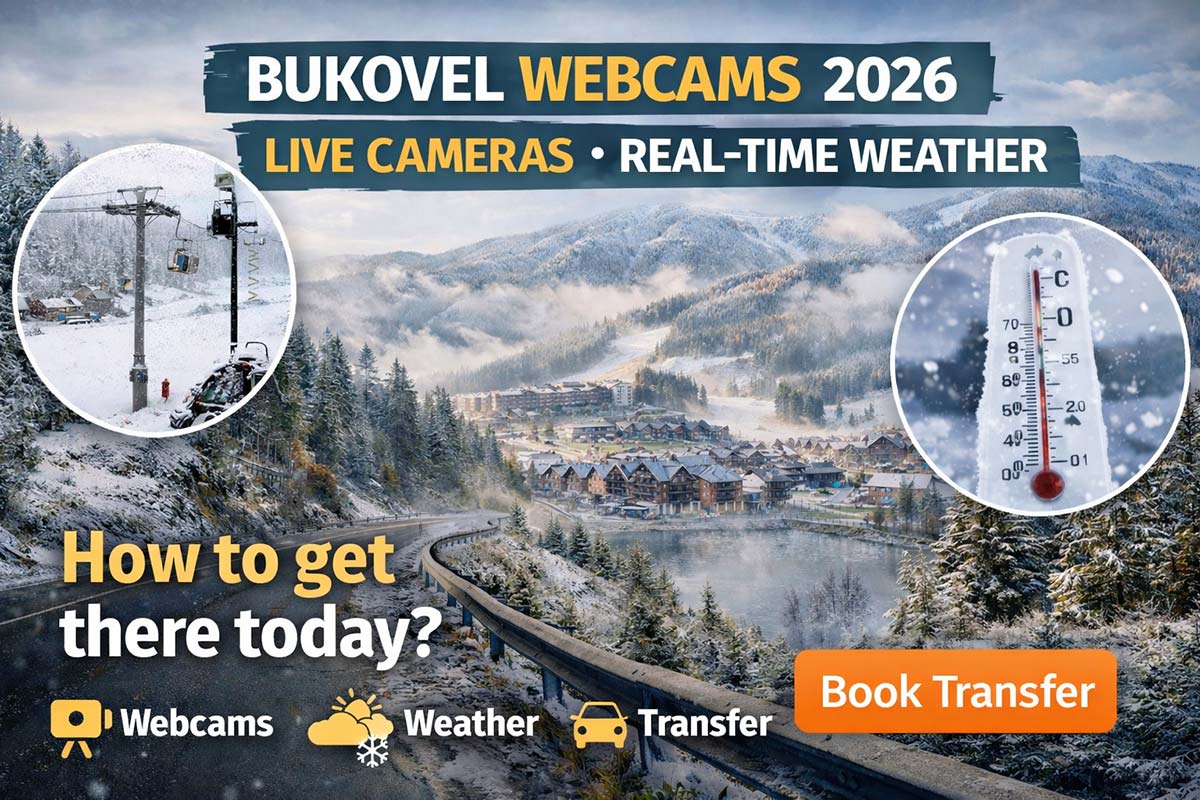
Bukovel live webcams are the fastest way to see what is actually happening at the resort right now. A forecast is useful, but a webcam shows facts: visibility, fog level, precipitation type, how the slopes look, whether snow is dry or wet, how windy it appears at higher elevations, and what the base area looks like in real time. That is why people search for webcams first: they check the live picture, confirm the weather, then decide whether to drive today, postpone, or adjust the itinerary.
This page is structured for practical use in 2026. It explains how to read Bukovel webcams correctly (not just “look at the image”), what live cameras reveal that weather apps often miss, how to evaluate road conditions by visual signals, and how to plan a same-day trip with predictable timing. A dedicated block “How to get to Bukovel today” is included, plus a direct booking button for a private transfer.
2026 Webcam Update: What Changed and What to Expect
In 2026, Bukovel webcams remain one of the most reliable “decision tools” for travelers. The practical rule is simple: rely on multiple camera angles, not one stream. A single camera can be temporarily unavailable, covered by snow, affected by glare, or placed in a micro-zone that does not represent the entire resort. Two to four live views usually provide a complete picture: one at the base area, one aimed at lifts or a central zone, and one that gives you a sense of higher elevation weather (cloud ceiling, wind, fog movement).
Some webcam streams can be intermittently offline due to technical maintenance, unstable connectivity during heavy precipitation, or equipment updates. That does not mean the resort is “closed” or the weather is “bad.” It simply means a single source is temporarily unavailable. For trip planning, the goal is not perfect coverage; the goal is enough real-time evidence to choose the right departure time and the right travel format.
Why People Use Bukovel Webcams Before a Trip
Webcams answer the questions that matter for a same-day decision:
- Visibility: clear, moderate, or near-zero due to fog and low clouds.
- Precipitation type: snow, wet snow, rain, or mixed precipitation.
- Surface signals: dry snow vs. wet snow, slush, or melting conditions at the base.
- Wind cues: drifting snow at higher points and rapid cloud movement that suggests strong gusts.
- Resort activity: crowd density at the base area and lift lines (useful for timing arrivals).
- Road and access hints: wet pavement, slush at roadside edges, and overall visibility on approach roads.
In the Carpathians, two conditions can coexist at the same time: a mild “plus” temperature at lower elevations and a stable “minus” at higher elevations; drizzle at the bottom and snow at the top; clear skies in one valley and thick fog just a few kilometers away. A forecast can average these differences. Webcams show them.
Where Bukovel Webcams Are Typically Located
Bukovel cameras are positioned to show key resort zones without exposing private details. The exact list of streams may change over time, but the most useful categories remain stable. When travelers search for “Bukovel webcam,” they usually want these angles:
- Base area / central resort view: overall weather at the bottom, visibility, and the general atmosphere.
- Lift zones: lift lines, platform visibility, and how precipitation affects operations.
- Slope-facing angles: surface condition, snow quality cues, and whether the slope looks windblown or wet.
- Higher elevation viewpoints: cloud ceiling and fog movement, often the biggest factor for planning.
- Lake and promenade areas: wind exposure and precipitation intensity in open zones.
For planning, the most accurate approach is to compare at least one “lower” camera and one “higher” camera. If the lower camera looks clear but the higher one is fully inside clouds, the day can still be enjoyable, but driving timing and expectations should adjust. If both are clear, the situation is generally stable. If both are foggy, the “today” decision becomes mostly about timing and comfort rather than perfect visibility.
How to Read Bukovel Webcams Correctly
Webcam viewing becomes useful when it is structured. Randomly checking one camera often leads to wrong conclusions. A practical method is to read webcams in three layers: visibility, precipitation, and surface/road signals.
1) Visibility: Fog, Cloud Ceiling, and Contrast
Fog is not just “bad view.” In the mountains, fog changes safety and pace: driving is slower, slope contrast is reduced, and higher stations can sit inside clouds even when the base looks fine. On webcams, fog and low clouds are visible through:
- washed-out backgrounds and disappearing ridgelines;
- loss of detail in distant buildings or tree lines;
- flat light with no clear shadows even during daylight;
- rapid changes in background clarity within minutes (moving cloud layers).
Fog often lifts later in the day, especially after sunrise when temperature and wind patterns shift. Webcams allow you to decide whether to depart immediately or wait for a better window.
2) Precipitation: Snow vs. Wet Snow vs. Rain
The difference matters. Dry snow changes driving less than wet snow that turns into slush; rain at the base can mean wet clothes and reduced comfort, while snow at the top can mean good conditions if visibility is acceptable. On webcams, precipitation can be inferred from:
- dry snow: crisp white coverage with minimal surface shine and stable texture;
- wet snow: reflective surfaces, heavier accumulation on edges, and quick “darkening” of roads;
- rain: dark pavement, water sheen, drops on the lens, and blurred contrast.
For a same-day trip, precipitation type impacts the departure time and the travel format choice. A private transfer eliminates outdoor waiting and makes the weather variable less stressful.
3) Surface and Road Signals: What the Camera Tells You About Driving
Road conditions in the mountains can shift quickly. Even if the route is open, the pace can change due to wet pavement, slush, or overnight freezing. Webcams near the resort often show enough detail to infer the likely approach conditions:
- bright reflective pavement indicates water film or wet surface;
- dirty snow “banks” and slush at edges indicate transitional conditions;
- dark patches that look “glassy” early in the morning can indicate refreezing;
- reduced visibility on curves and valley sections suggests slower average speed.
This is why webcams are used as a final reality check. A forecast might say “light precipitation,” but webcams show whether it is rain, wet snow, or a stable snowfall. That changes travel comfort and the time buffer required.
How to Use Webcams for a Same-Day Decision
A common behavior pattern for travelers is consistent and logical. In 2026, the “webcams → weather → trip plan” chain looks like this:
- Open 2–4 webcams from different zones (base + lift area + higher viewpoint).
- Determine visibility and fog intensity.
- Identify precipitation type (snow, wet snow, rain, mixed).
- Check surface signals (wet pavement, slush, refreezing patterns).
- Compare with forecast to understand the next 3–6 hours trend.
- Choose departure timing and the travel format: private transfer, train + transfer, bus, or self-drive.
When the decision is “go today,” predictability becomes more valuable than theoretical savings. The fastest way to simplify the process is to secure door-to-door transportation and eliminate transfers, waiting, and uncertainty.
How to Get to Bukovel Today (2026)
Same-day travel is mainly about timing control and minimizing dependencies. Webcams help you pick the right window; a private transfer helps you execute the plan without schedule gaps and uncomfortable waiting. Below are practical “today” scenarios used by most travelers.
Scenario A: You are in Ivano-Frankivsk and want to leave today
Ivano-Frankivsk is the most common gateway (airport arrivals, train station, bus arrivals). For a same-day departure, the most predictable option is a private transfer from your exact pickup point to your Bukovel address (hotel, chalet, residence in Polianytsia or the resort area). Route page:
Booking and pricing:
Scenario B: You are in Kyiv and want to leave today
Kyiv → Bukovel is a long route. Same-day travel is easier when the format is controlled: direct transfer without transfers and without waiting for connections. Route page:
Scenario C: You arrive by train to Tatariv and need a pickup immediately
Tatariv is a strategic rail access point when time matters. For a same-day arrival, a pre-arranged pickup removes uncertainty and avoids searching for transport at the station in poor weather. Practical page:
Scenario D: You start from Vorokhta and want to get to Bukovel today
Vorokhta is often used as a base or a stopover. For a short and controlled ride to the resort area:
Scenario E: You consider the bus option
The bus format works best with flexible timing. Same-day decisions can be harder when departures are limited. Reference page:
Operational Contact for a Same-Day Plan
For immediate coordination, pickup address confirmation, and timing adjustments:
Private Transfer vs. Other Formats: Why It Matters in Real Weather
Webcams often reveal transitional conditions: wet snow, rain at the base, fog, and visibility changes. In these scenarios, comfort and predictability come from removing outdoor waiting and reducing the number of steps. A door-to-door transfer is typically chosen when:
- there is a strict arrival time at the hotel for check-in or reservations;
- travel involves luggage, sports equipment, or children;
- weather is mixed and waiting outside is undesirable;
- the trip is “today,” and the plan must execute smoothly.
Booking reference pages that support fast planning:
What Webcams Reveal About the Resort “Right Now”
In Bukovel, the most significant difference between “good day” and “difficult day” is often visibility, not temperature. Webcams show whether the resort is under a clear sky, a low cloud ceiling, or intermittent fog. They also show whether precipitation is localized or widespread.
Real-time visibility helps set realistic expectations for:
- scenic views and photo opportunities;
- driving pace on approach roads;
- the comfort level of walking between hotel, restaurants, and resort zones;
- the value of choosing a private transfer instead of a multi-step route.
Webcams also help choose the best arrival window. A midday arrival can be more comfortable than early morning when fog and overnight refreezing are more likely. A late afternoon arrival can be faster due to lighter traffic in some weeks, but may be riskier for visibility and temperature drops. A live camera view helps choose the right compromise.
Road Conditions Near Bukovel: Visual Indicators Travelers Use
Many travelers check webcams specifically to infer road and access conditions near the resort. This is especially relevant in late autumn, early winter, and spring transitions. Webcams do not replace road services, but they show clear signals that matter for planning:
- Wet road shine: higher chance of slower pace, especially in curves and shaded sections.
- Slush at edges: transitional snow scenario; a transfer or an experienced driver improves predictability.
- Morning refreeze cues: darker glossy patches early in the day indicate potential slippery spots.
- Visibility on approach curves: fog in valley sections implies reduced average speed.
For travelers arriving to flights or trains, the safer planning model is a buffer. For travelers arriving “today,” the safest comfort model is removing unnecessary waiting and transfers and using a direct ride to the hotel.
Internal Pages That Support Webcam-Based Trip Planning
Webcams are the start of decision-making. The next step is logistics: route, timing, and booking. The following internal pages cover the most common planning needs in 2026:
- Transfer prices and booking
- Ivano-Frankivsk → Bukovel transfer
- Kyiv → Bukovel transfer
- Private bus to Bukovel
- Contacts
- About the service
Alternative-day planning (when webcams show poor visibility or heavy precipitation) is also common. These pages help structure a “non-ski” day or a flexible program in the region:
- Jeep tours in Bukovel
- ATV tours in Bukovel
- Rafting tours near Bukovel
- Yaremche excursion
- Verkhovyna excursion
FAQ: Bukovel Webcams, Weather, and Getting There Today
Are webcams more reliable than a forecast?
A forecast describes expected conditions across a wider area. A webcam shows the actual situation in a specific zone at a specific minute. For a “go today” decision, webcams are often more practical because they show visibility, precipitation type, and real surface signals.
Do all webcams work continuously?
Webcams are designed for continuous operation, but individual streams can be temporarily unavailable due to maintenance, weather-related connectivity issues, or equipment updates. Using multiple camera angles reduces dependence on a single stream.
What if one camera is offline?
Relying on 2–4 different viewpoints is the practical method in 2026. If one stream is unavailable, the remaining cameras usually provide enough real-time information for a decision.
What is the fastest way to get to Bukovel today without transfers?
A private door-to-door transfer from your exact pickup point to your hotel address provides the most predictable same-day arrival, especially in fog, rain, or wet snow conditions. Key route pages:
Where is the simplest place to book a transfer?
The booking and pricing page centralizes the service flow:
Why do webcams help even if the trip is already planned?
Webcams help adjust departure timing, estimate visibility, understand precipitation type, and infer whether roads and surfaces are likely wet or refreezing in the morning. This is especially valuable in transitional mountain weather.
